San Jose, CA · Garage Door Service
Los Altos homes built around 1964 run older track hardware that shifts off-rail with age, not weather. Here's what the fix involves and what it costs to skip it.
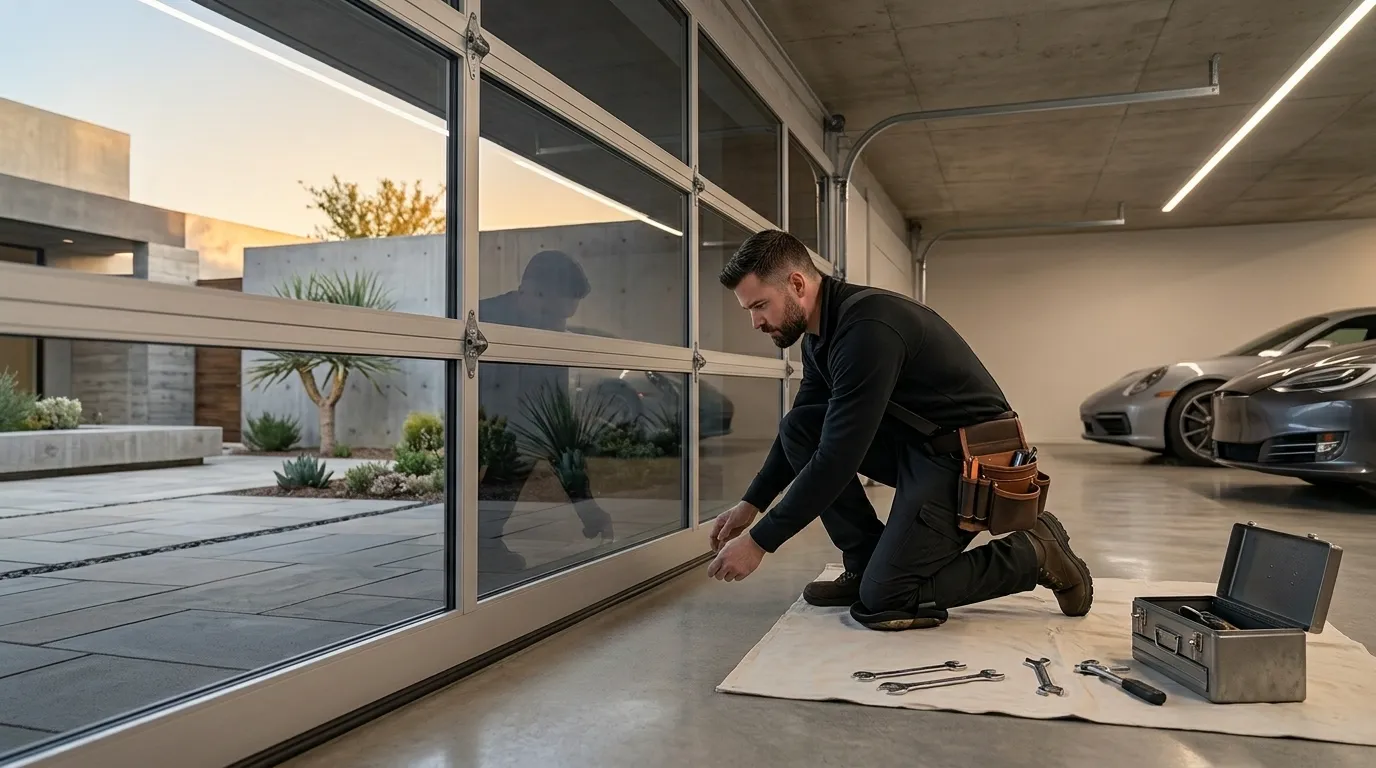
We don't keep a truck parked in Cupertino. We run out of San Jose, about 13 miles away, so when you call we're giving you a real answer based on that drive, not a promise that we're already around the corner. That's the honest version of it: the job gets scheduled, the truck comes from San Jose, and the distance is part of the math.
What that means for you: if a spring lets go on a Tuesday morning, we're not going to pretend there's a local depot we're rolling out of. We're planning the drive same as any other call in this part of the service area. Where it helps is that Cupertino sits close to several other stops we already make regularly - Saratoga, Los Altos, the Cupertino side of Los Altos Hills - so a call here often lines up with a run we're already making that day rather than a special trip on its own.
The typical house in this part of Cupertino went up around 1973. That's a specific window, and it matters because garage door hardware changed fast through the 1970s. Homes from right around that year are the ones most likely to still have an original extension-spring setup mounted along the horizontal track, rather than the torsion spring over the header that became standard as the decade went on. Extension springs from that era don't have the safety cables that later code required, and parts for the original openers, if they're still in place, are long out of production.
We're not going to tell you every door from 1973 needs replacing - plenty of them have been reworked over the years with newer torsion hardware and a modern opener bolted on. But if your panel, track, and springs all look original, that's the tell. The honest limitation here: if what's failing is a proprietary opener drive from that period, we may not be able to source an exact replacement part, and the straighter path is swapping the opener rather than chasing obsolete pieces.
Cupertino counts about 21,137 households, a small slice of the roughly 173,742 across the full service area we cover out of San Jose. Median household income here runs $231,139, noticeably above the $214,149 median for the wider area - which shows up in the kind of door work we get called for. More owners here are asking about insulated steel or wood-composite panels and quieter belt-drive openers rather than the base steel section and chain-drive combination that's more common elsewhere in the coverage area.
The climate doesn't force any special hardware - this whole region sits in a mild temperate band, so we're not dealing with the freeze-thaw cycling that cracks panels or seizes rollers in colder climates. What ages a door here is mostly just time: forty-plus years of daily cycles on the same torsion spring, tracks that have gone slightly out of alignment, weatherstripping that's hardened and cracked. None of that is dramatic. It's just what happens to hardware that's been doing its job quietly since the early '70s.
The run from San Jose to Cupertino is about 13 miles, and it's one we make often - Cupertino sits in the middle of a cluster of stops we cover regularly, with Saratoga about 12 miles out and Los Altos around 16. That's useful in practice: a spring repair booked for Cupertino frequently shares a route with a call in one of those nearby areas, which keeps scheduling realistic instead of guesswork.
We don't route through areas outside our regular coverage to get here, and we're not going to claim a shortcut that doesn't exist. It's a straightforward drive down from San Jose, same as for the other communities on the west side of our service area. If you're near the edge of Cupertino and closer to Saratoga or the Los Altos Hills side, mention that when you call - it can affect which part of the day works best for scheduling.
No. We operate out of San Jose and travel to Cupertino for every job, about 13 miles each way. We're upfront about that distance rather than implying a local depot that doesn't exist.
Possibly. Homes from around 1973 often started with extension springs and openers without today's safety features. If your panel and track look original, it's worth having the spring type and opener checked, since parts for that generation are often discontinued.
Not particularly. This area sits in a mild temperate climate band, so we don't see the freeze-thaw damage that cracks panels or seizes hardware in colder regions. Wear here comes mostly from age and daily use rather than weather extremes.
Sometimes, but not always. Panel styles from that era are frequently discontinued, so matching depends on what's still available. In many cases replacing the full door ends up being more practical than hunting for one matching section.
Call now or request a free quote - same-day service on most repairs, upfront written pricing.
Most off-track calls in Los Altos start the same way: a roller has walked out of the track, usually at a bent section near the bottom bracket, and the door is either wedged at an angle or won't move at all. The fix means backing off cable tension, working the door back onto the rail by hand, checking the track brackets for stripped lag bolts, and replacing any roller that's chewed up the track edge on its way out.
What makes this different in Los Altos is the housing itself. The area's homes went up mostly around 1964, and a lot of that original hardware is still hanging on the wall. Steel track from that era wasn't galvanized the way current stock is, so after decades of expansion and contraction the metal develops soft spots where it flexes instead of holding its line. A door can ride fine for years and then walk off-track the first time a spring loses a little tension, because the rail no longer has the stiffness to keep it corrected.
We also see this on doors that were converted from single-piece to sectional at some point without swapping the track hardware to match. The bracket spacing ends up wrong for the panel weight, and the door rides slightly crooked until one hard stop knocks a roller clean out of the channel.
We carry standard-width steel track sections, nylon and steel rollers, and universal bottom brackets on the truck, which covers the majority of off-track jobs regardless of door age. Track for older or oddball door widths sometimes has to be ordered, and if a bracket has torn loose from rotted jamb wood behind it, that's a carpentry fix first, door fix second - we'll tell you straight if that's what we're looking at rather than forcing a hardware repair onto a bad mounting surface.
One honest limitation: if the track itself is original to a 1964 build and has developed rust pitting along its full length rather than one bent section, patching it is a short-term move. We'll say so instead of billing you twice.
An off-track door is dangerous to force back into place if the spring is still under load, because the panel can drop the moment a roller frees up. We see this go wrong most often when a homeowner has already tried to muscle the door back on-rail before calling, and in doing so has bent the track further or pulled a bracket loose from the framing.
The other place this gets complicated is when the off-track event is really a symptom, not the problem. A door that's been slightly out of square for months from a worn roller will eventually jump the track entirely. Fixing the track without addressing the roller wear just buys you a repeat visit.
If the door is only an inch or two off the rail and the springs are relaxed (door mostly down, no tension on the cables), you can sometimes walk it back on by hand. Anything beyond that - a door hanging at an angle, a cable that's come off its drum, or a spring that's still wound - is not a solo job. The failure mode isn't a stuck door, it's several hundred pounds of panel and coiled steel letting go while you're standing under it.
If you're not sure which situation you've got, that uncertainty is itself the answer: call it in.
The tell in Los Altos is usually a grinding or scraping sound right before the door stops, followed by the door sitting crooked in the opening - lower on one side, or tilted enough that daylight shows unevenly along the bottom seal. Sometimes it's quieter: the opener runs, the door doesn't move, and the motor just strains against a chain that's still turning.
Because the local climate here stays mild rather than swinging through hard freezes, we don't see the seasonal expansion-and-contraction failures that show up in colder markets. What we see instead is straightforward material fatigue - track and brackets that have simply been doing their job since the 1960s and are done. That's a fault that shows up on its own timeline, not a weather event, which is why it can surface any month of the year.
In this area it's usually age, not weather. A lot of the housing here dates to around 1964, and original track hardware from that period wasn't built to the same rust-resistance standard as current stock. Decades of small flex eventually create a soft spot in the rail, and a roller finds it.
If the door is stuck partway open, don't force it and don't park under it. Leave it as-is and call for a repair. A door hung on one side with the spring still under tension can shift further on its own, especially overnight when nothing's holding it steady.
We stock standard-width steel track, rollers, and bottom brackets on the truck, which covers most calls. Some older or non-standard widths need to be ordered in, and we'll tell you upfront if your job is one of those before starting work.
Los Altos is about 16 miles from our San Jose base. We don't run a branch location in Los Altos itself - the truck comes from San Jose for each job.